In February 1637, a single tulip bulb in the Netherlands could theoretically buy a canal house in Amsterdam. That sentence sounds like an exaggeration cooked up for a textbook, but it’s rooted in real price records from the period, even if historians still argue about exactly how widespread the phenomenon was. Nearly four hundred years later, tulip mania remains one of the most referenced episodes in financial history, invoked every time markets start behaving strangely, whether it’s dot-com stocks, cryptocurrency, or meme stocks. But what actually happened, and does the popular story hold up to scrutiny? I think it’s worth separating myth from mechanism here, because the real lessons are more nuanced than “people got greedy and it ended badly.”
How a flower became a financial instrument
Tulips arrived in Western Europe from the Ottoman Empire in the mid-1500s, and by the early 1600s they had become a status symbol among the Dutch merchant class. The Dutch Republic at the time was riding an extraordinary wave of prosperity thanks to global trade routes controlled largely by the Dutch East India Company. There was real wealth floating around looking for somewhere to go.
Tulips were unusual because certain varieties, especially those infected with a mosaic virus that caused striking flame-like petal patterns, were genuinely rare and unpredictable to cultivate. A bulb might take seven to twelve years to flower from seed, and the virus that created the most prized patterns couldn’t be reliably reproduced. Scarcity plus aesthetic obsession plus a wealthy merchant class equals the perfect setup for speculation.
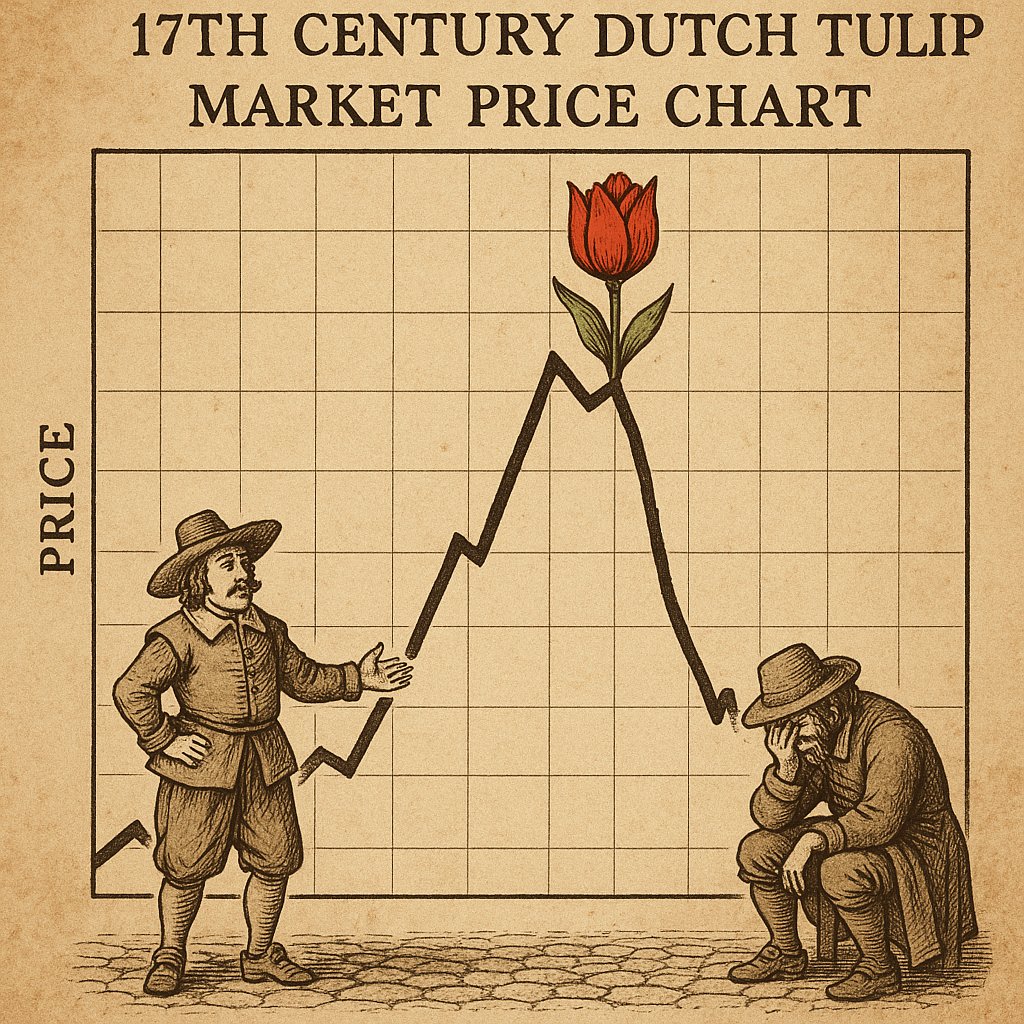
By 1636, trading had moved beyond actual flower enthusiasts. Ordinary tradesmen, weavers, and innkeepers were buying and selling futures contracts on bulbs that hadn’t even been planted yet. Prices for some bulbs, like the famous Semper Augustus, reportedly reached thousands of guilders, at a time when a skilled craftsman might earn a few hundred guilders a year.
The mechanics of the mania: what was actually being traded
One detail that often gets lost is that tulip mania wasn’t really a market for flowers. It was a market for paper promises to deliver flowers at a future date, traded informally in taverns rather than on any regulated exchange. This is a subtle but important point: contracts changed hands multiple times before any bulb was ever dug up or exchanged. In modern terms, people were trading derivatives on an asset most of them never intended to physically hold.
This created a feedback loop familiar to anyone who has studied later bubbles:
- Rising prices attracted new buyers who had no interest in gardening, only in reselling at a profit.
- Sellers demanded no upfront capital in many cases, since contracts were often settled with a small deposit, effectively creating leverage.
- Word of quick profits spread through social networks, pulling in people who feared missing out rather than those making a calculated investment.
The collapse came fast. In early February 1637, at a routine bulb auction in Haarlem, buyers simply failed to show up. Confidence evaporated almost overnight, and prices reportedly fell by more than 90 percent within weeks. Because so much of the trading had been informal and contract-based, the legal aftermath was messy for years, with courts eventually ruling that many contracts were more like gambling debts than enforceable trades.
Separating exaggeration from evidence
Here’s where it gets interesting for anyone who likes rigorous history. Economic historian Anne Goldgar, in her research published in the 2000s, found that the mania’s economic impact on the broader Dutch economy was likely far smaller than popular accounts suggest. The idea that tulip mania bankrupted the nation or caused widespread ruin appears to be largely a later exaggeration, partly fueled by moralizing pamphlets written after the crash to warn against greed. The actual number of people financially devastated may have been relatively small and concentrated among speculators, not the general population.
This matters because it changes the lesson. Tulip mania wasn’t necessarily proof that entire societies lose their minds during bubbles. It’s better understood as an early, well-documented case study in how speculative behavior spreads through a specific network of participants when leverage, scarcity, and social proof combine.
Why this 17th-century story still shows up in economics classrooms
Every generation seems to rediscover the same pattern. The South Sea Bubble of 1720, the railway mania of the 1840s, the dot-com crash of 2000, the housing bubble of 2008, and more recently certain corners of the crypto market in 2021-2022 all share structural similarities with tulip mania, even though the underlying assets couldn’t be more different.
A few recurring ingredients tend to show up across these episodes:
- An asset with a plausible, even exciting, narrative attached to it (rare beauty, new technology, disruptive innovation).
- Easy access to credit or leverage that lets people bet more than they could otherwise afford.
- A feedback loop where rising prices themselves become the primary justification for buying.
- A trigger, often small and seemingly unrelated, that causes confidence to reverse suddenly.
What strikes me most, having read through both the classic and revisionist accounts, is how little the psychological mechanics have changed over four centuries. The instruments are different, the speed is different, but the underlying human tendency to chase momentum and rationalize prices based on other people’s behavior looks remarkably consistent.
Practical takeaways for thinking about modern markets
You don’t need to be a professional trader to apply the lessons here. A few questions worth asking whenever an asset’s price seems to be climbing faster than any reasonable estimate of its underlying value:
- Is the price being driven by actual use or utility, or mainly by expectations of future resale?
- How much of the buying is happening on credit or leverage rather than with capital investors can afford to lose?
- Would this investment still make sense if nobody else was talking about it?
- What happens to confidence if a single, ordinary event, like a routine auction with low turnout, occurs?
None of these questions guarantee you’ll avoid a bubble, and plenty of smart, careful people got caught up in tulip mania and its successors. But asking them at least forces a pause, which is often the one thing missing in the middle of genuine market euphoria.
Tulip mania endures as a cultural reference not because it was the largest or most economically damaging bubble in history, but because it’s compact, vivid, and easy to tell as a story. A flower, briefly, became worth more than a house. That image sticks. The real value in revisiting it today isn’t nostalgia for Dutch history, it’s a reminder that markets are ultimately made of people, and people have been susceptible to the same patterns of enthusiasm and panic for as long as we’ve had markets at all. If this period intrigues you, digging into primary sources like the original pamphlets and court records from the 1630s offers a fascinating, less sanitized view of how the whole episode actually unfolded.








