Author: Simon Walsh

  • Arranging mixed flower stems in a narrow-neck vase

    Mixed flower stems in a narrow-neck vase can look tidy for a day and then lean, split apart, or slide to one side. The small opening limits how many stems fit and how far each one can move. It also works as a built-in support, because the neck holds stems in place if you load it in the right order. The steps below cover cleaning the vase, stripping leaves, supporting stems, and adjusting the arrangement without overfilling it.

    Preparing a clean vase for mixed flower stems

    Narrow necks hide residue. Wash the vase with hot, soapy water and a bottle brush. If the brush will not fit, add a spoonful of uncooked rice and a little soapy water, then swirl hard to scrub the inside walls. Rinse until there is no soap smell, since leftover film clouds fresh water quickly.

    Fill the vase with cool water to about half or two thirds of its height. If a flower food packet came with your stems, mix it according to the directions on the package, because the amount depends on the water volume.

    Before you cut anything, lay the stems on a table and sort them by role. Tall, linear stems form the outline. Round or large blooms become the focal points. Small filler flowers cover gaps, and branches or greenery give structure. A common rule of thumb is to make the tallest stem about one and a half times the height of the vase, though a wide-bellied vase may look better with shorter stems.

    Stripping leaves below the waterline

    Any leaf that sits under water starts to break down and turns the water cloudy. Pull these leaves off by hand, working downward along the stem, or snip them with scissors. Do this before you place the stem, because reaching into a narrow neck later is awkward and tends to bend other stems.

    Also remove leaves that would sit right at the neck. They crowd the opening and block space that stems need. Leave the foliage higher up, where it can fill gaps in the arrangement.

    Trim each stem at a diagonal with clean, sharp scissors or shears, taking off about an inch. Dull blades crush the stem. Thorny stems such as roses can be stripped gently with a folded cloth to protect your fingers.
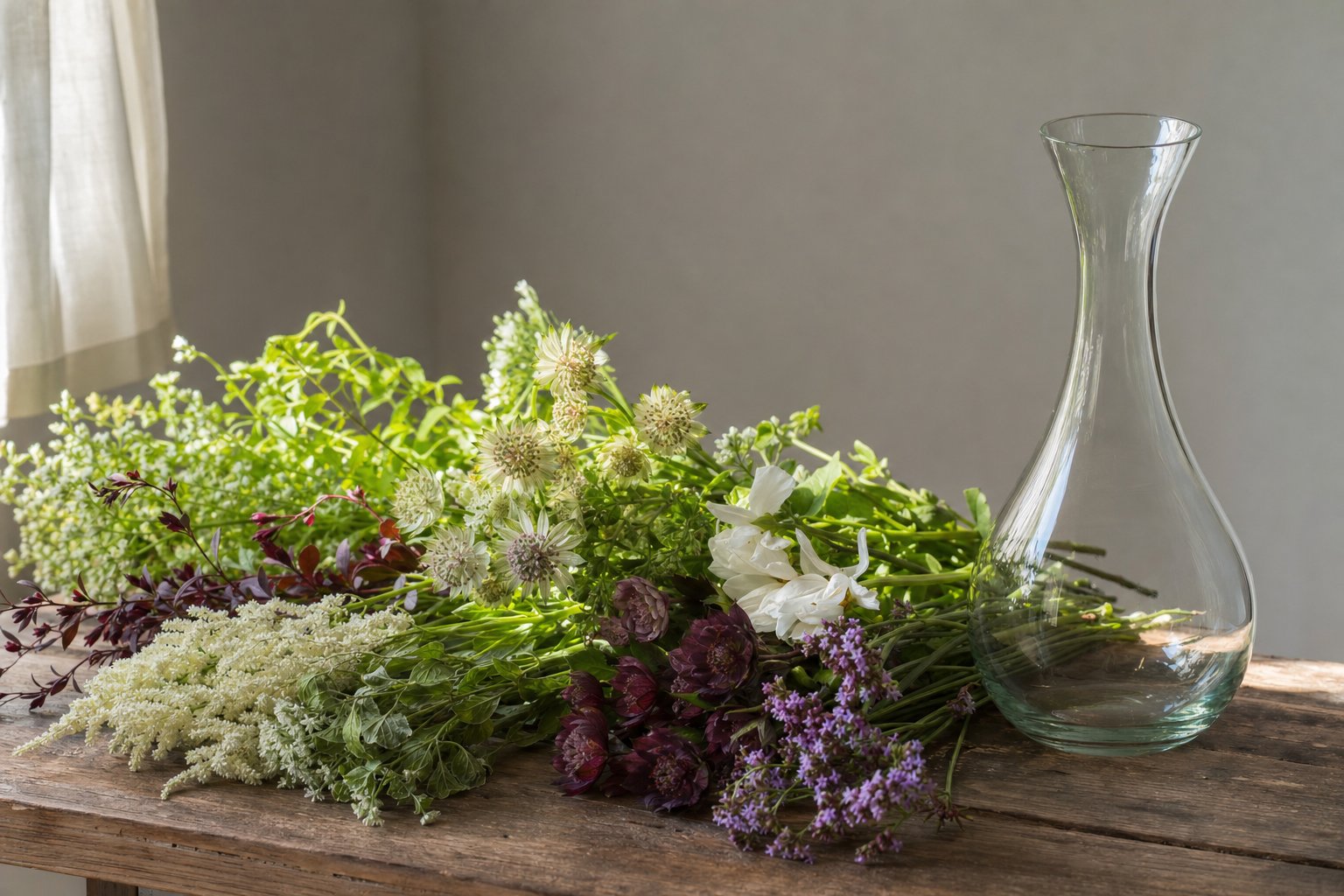
    Still life of sorted mixed stems beside a narrow-neck glass vase
    Illustration: Still life of sorted mixed stems beside a narrow-neck glass vase.

    Supporting stems inside a narrow opening

    Before placing anything, it helps to have a picture of the proportions you want. A florist catalog, such as the one for flower delivery to Atlanta, lets you compare how finished bouquets pair tall stems with rounder blooms and filler. You can borrow the ratio at home, even with different flowers.

    Build the arrangement in layers, and let the neck do the holding:

    1. Start with sturdy foliage or branches. Cross two or three of them inside the neck so they form a loose lattice.
    2. Add the tallest line stems next, placed slightly off center.
    3. Insert the focal blooms at varied heights, with the lowest ones resting near the rim.
    4. Slide filler stems into whatever gaps remain.
    5. Turn the vase and look from every side before adding more.

    When stems keep falling over

    • Heavy heads such as large dahlias or hydrangea pull stems sideways. Cut them shorter so the head rests closer to the rim.
    • Thin stems slip through the lattice. Pair two together with a small rubber band placed above the waterline.
    • Stems that drift to the edge can be wedged with a short piece of foliage tucked in beside them.

    Add stems at a slight angle, all leaning in the same direction, the way a hand-tied bouquet is built. The stems cross at the neck and spread out above it, which gives the arrangement a natural fan shape without any tape or foam.

    Adjusting without crowding

    A narrow neck fills up faster than it looks. Stop adding stems while you can still wiggle each one a little. When everything is wedged tight, moving one stem drags its neighbors with it.

    To fix a stem, lift it out slowly and straight up instead of yanking it sideways. If a bloom sits too high, pull it out, trim another half inch to an inch, and set it back. If an area looks heavy, remove one stem rather than rearranging five. Subtracting often improves the shape more than adding does.

    Take a quick photo from across the room. A phone camera flattens the arrangement and shows gaps or lopsided areas that are hard to notice up close.

    Check the water daily. Top it up when it drops, and replace it completely when it looks cloudy, trimming the stem ends again at the same time. Lift out any petals or leaves that fall into the neck, since they are difficult to reach later.

    For your next arrangement, sort the stems by height on a table first, strip the lower leaves, and photograph the vase after the foliage layer is in place. That photo gives you a reference for how much space remains before the neck gets crowded.
  • Lotus flower symbolism in Egypt, India and China

    Every morning, a lotus bud rises from muddy water, opens its petals to the sun, and by evening closes again. Now imagine watching this ritual 4,000 years ago on the banks of the Nile, in a pond in the Ganges plain, or in a Chinese monastery garden. You would likely draw the same conclusion in each place: something pure is emerging from darkness. Yet the three cultures read that image in surprisingly different ways. Here is how the lotus came to mean so much in Egypt, India and China, and why those meanings still turn up in tattoos, yoga studios and museum galleries across the United States.

    Why the lotus caught the human imagination

    The plant’s biology does most of the storytelling. Its roots sit in silt, its leaves repel water (a property scientists now call the “lotus effect,” which inspired self-cleaning coatings), and its flower opens and closes in a daily rhythm. Some species also produce seeds that stay viable for centuries. Researchers have germinated lotus seeds recovered from a dry lake bed in China that were roughly 1,300 years old.

    A quick note on terminology: the flower in Egypt was usually the blue water lily (Nymphaea caerulea) and the white Nymphaea lotus, which are technically water lilies. The sacred lotus of India and China is Nelumbo nucifera. Ancient artists and later writers blended the two, and the symbolism overlaps for good reason.

    Egypt: the flower that opened the world

    Creation and the sun

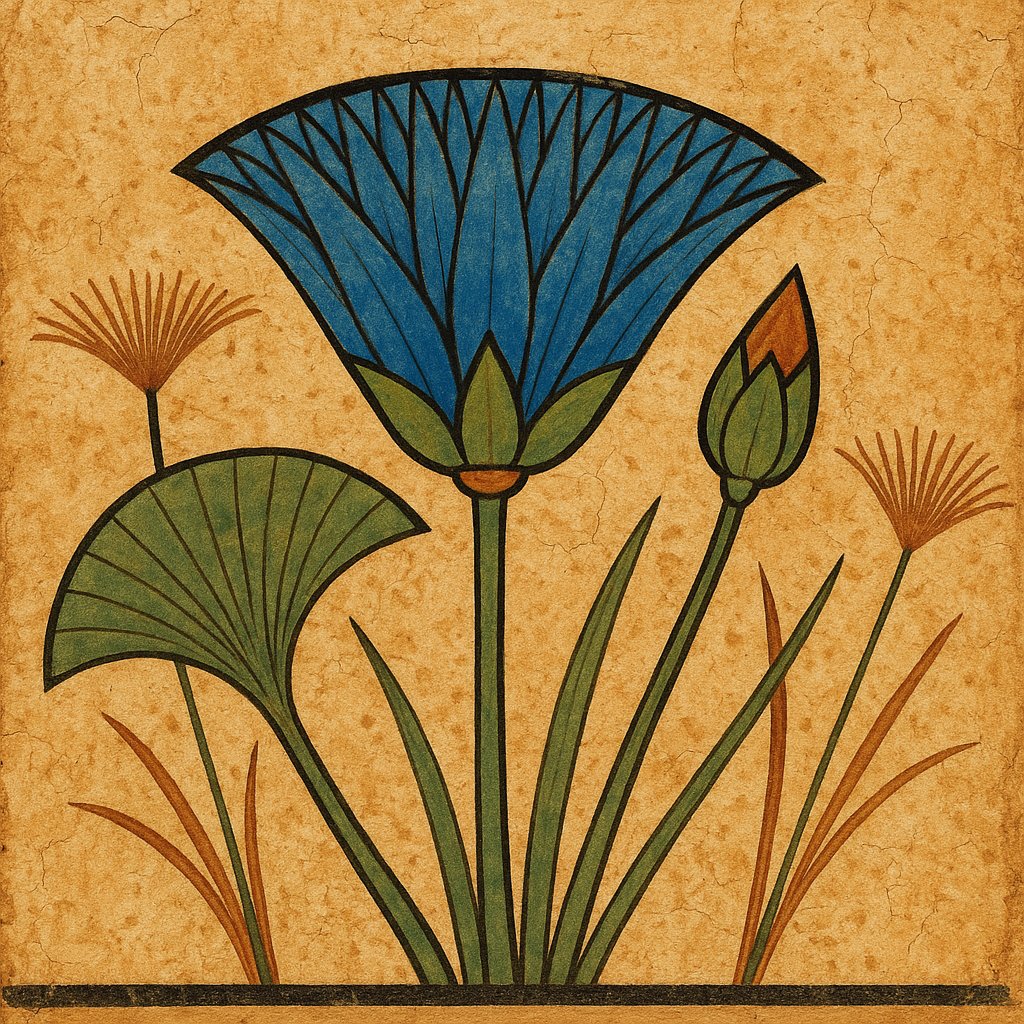
    In Egyptian cosmology, the world began as dark, watery chaos called Nun. According to the Hermopolitan and Heliopolitan traditions, a lotus rose from those waters and opened to reveal the young sun god, whose light began creation. It is easy to see the logic: every dawn on the Nile, blue lilies unfurled at sunrise and sank slightly at dusk.

    Rebirth after death

    This is why the lotus appears so often in funerary art. Chapter 81 of the Book of the Dead contains spells allowing the deceased to transform into a lotus and be reborn. Tutankhamun’s treasures include a famous painted wooden head of the boy king emerging from a blue lotus. Mourners and banquet guests in tomb paintings hold the flower to their noses, perhaps for its mild sedative scent, perhaps for its symbolic promise of renewal.

    Upper Egypt’s emblem

    The lotus also had a political life. It stood for Upper Egypt, paired with papyrus for Lower Egypt, and columns carved as lotus and papyrus bundles still hold up temple halls at Luxor and Karnak. Together they expressed a unified kingdom.

    ancient Egyptian tomb painting of a blue lotus flower

    India: purity that does not cling

    In India the lotus (padma or kamala) is less about the sun’s first dawn and more about the spiritual life. The central image is a flower that grows in mud yet stays unstained. The Bhagavad Gita (5.10) says that a person who acts without attachment is untouched by sin, “as a lotus leaf is untouched by water.” I find that line one of the most practical readings of the symbol: engage with the world, but do not be coated by it.

    • Hinduism: Vishnu is born with a lotus growing from his navel, from which Brahma emerges to create the universe. Lakshmi, goddess of prosperity, sits or stands on a lotus. Saraswati is often shown with one too.
    • Buddhism: Legend says the infant Buddha took seven steps and lotuses bloomed beneath each foot. Buddhas and bodhisattvas are commonly seated on lotus thrones. A closed bud, a half-open flower and a full bloom can represent stages on the path to awakening.
    • Yoga and the body: The “thousand-petaled lotus” at the crown of the head represents the highest state of consciousness in tantric traditions, and the seated pose padmasana takes its name from the flower.
    • National identity: The lotus has been India’s national flower since independence.

    Color matters here. Pink usually points to the Buddha himself, white to purity of mind, red to compassion and love, and blue to wisdom and the victory of spirit over senses.

    China: integrity, harmony and a scholar’s favorite

    Buddhism carried Indian lotus imagery into China, but the flower already had a Chinese life of its own. The best-known statement comes from the Song dynasty scholar Zhou Dunyi, whose essay “On the Love of the Lotus” (11th century) describes it as the gentleman among flowers: “rising from the mud yet unstained, washed by clear ripples yet not seductive.” For centuries Confucian scholars cited it as a model of moral integrity, especially for officials who were tempted by corruption.

    Chinese culture also loves a good pun. The word for lotus, lian (莲), sounds like words meaning “connected” and “continuous,” while he (荷) sounds like “harmony.” A lotus paired with a fish suggests surplus year after year, and lotus seeds, with their many pods, are linked to fertility and wishes for many children, which is why they feature in wedding sweets. In Chinese Buddhism, the Pure Land tradition imagines believers being reborn inside lotus blossoms in Amitabha’s paradise.

    Three cultures, one flower: what differs

    Culture Core idea Typical setting
    Egypt Creation, sun, rebirth after death Tombs, temple columns, funerary art
    India Spiritual purity, detachment, awakening Temples, deity iconography, meditation
    China Moral integrity, harmony, abundance Scholar paintings, festivals, folk art

    Put simply, Egypt looks at the lotus as a cosmic event, India as an inner path, and China as a code of conduct. The shared thread is emergence: something clean and luminous rising out of murk.

    Reading lotus imagery with a sharper eye

    The next time you see a lotus in a museum, a textile or a piece of jewelry, a few questions help. Is it blue and sharply pointed, like a water lily from the Nile? Is it a broad pink bloom with a seed pod, typical of Nelumbo? Is a deity seated on it? Is it paired with a fish or a bird? Those details usually reveal which tradition is speaking, and one carelessly chosen design can carry a very different message than the person wearing it intended.

    If this overview sparked your curiosity, a good next step is to look at primary sources: a translation of the Egyptian Book of the Dead, the Bhagavad Gita, or Zhou Dunyi’s short essay, which takes about two minutes to read. Seeing the lotus in the words of the people who revered it is a quiet, rewarding way to understand why a muddy-pond flower has held human attention for millennia.

  • How flowers use ultraviolet patterns to guide bees

    Stand in a garden on a bright June morning and you’ll see flowers pretty much the way any human sees them – yellow petals, red centers, maybe a splash of purple. Now imagine a bee hovering over that same bloom. It’s seeing something entirely different, something we’re biologically incapable of perceiving without special equipment. That’s because bees see ultraviolet light, and a huge number of flowering plants have evolved patterns invisible to us but glaringly obvious to a pollinator’s compound eyes. This isn’t some minor biological footnote – it’s one of the more elegant examples of co-evolution I’ve come across, and it explains a lot about why certain flowers thrive while others struggle to get pollinated at all.

    Why bees needed a different visual language

    Bee vision works on a different wavelength range than ours. Humans typically perceive light from about 400 to 700 nanometers – violet through red. Bees, on the other hand, can’t see red well at all, but they pick up wavelengths down into the ultraviolet range, roughly 300 to 400 nanometers. So while we’re drawn to a rose’s deep crimson, a bee mostly just sees a murky, low-contrast shape. Red doesn’t do much for them.

    What bees respond to instead is contrast and pattern – and that’s exactly what UV markings provide. Many flowers have UV-absorbing pigments concentrated near the center, surrounded by UV-reflecting tissue toward the outer petals. To a bee, this creates a sharp visual boundary, almost like a bullseye or a runway of light pointing straight toward the nectar and pollen. Researchers sometimes call these “bee guides” or “nectar guides,” and honestly, that name explains the function perfectly. It’s a built-in signpost.

    The bullseye effect – nature’s landing strip

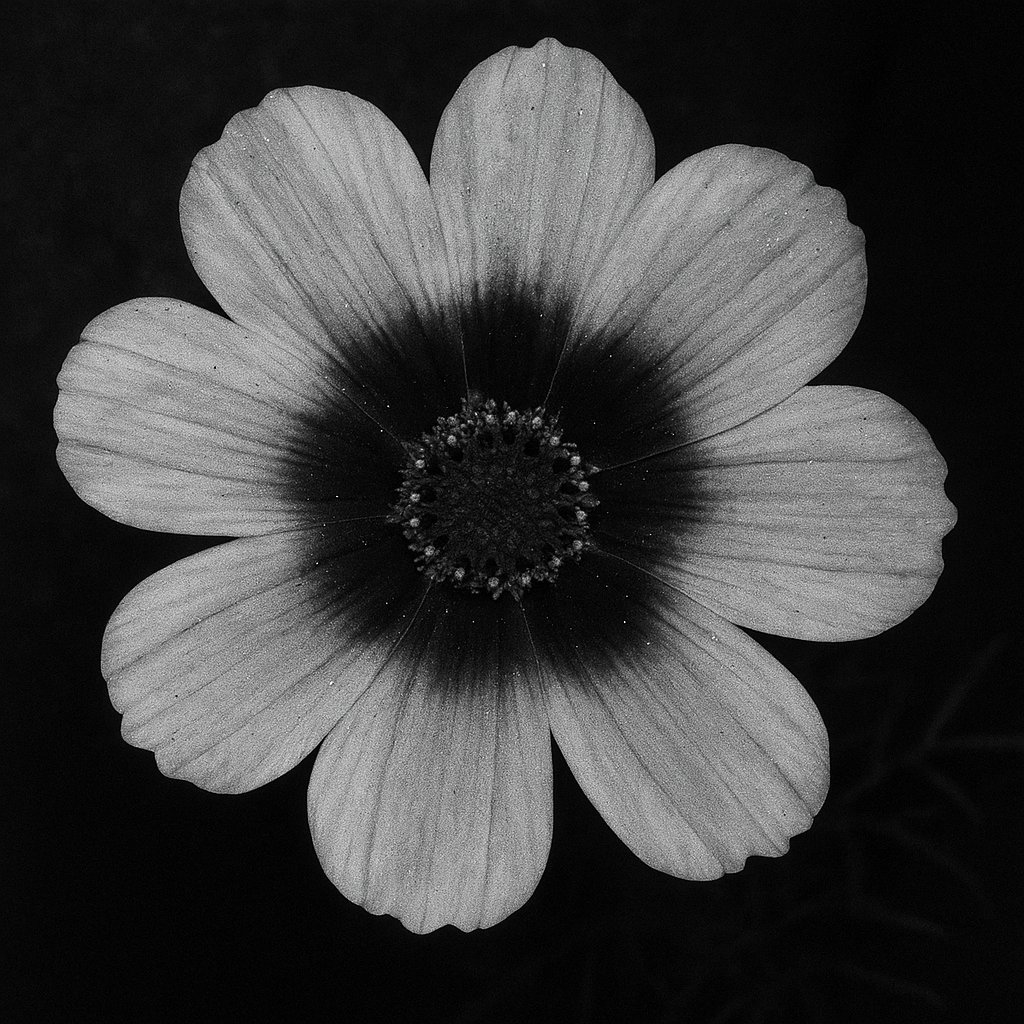
    I find this part particularly satisfying to explain because it’s so visually intuitive once you see it. Flowers like black-eyed Susans, evening primroses, and sunflowers look fairly uniform to us – yellow petals, yellow center. Under ultraviolet photography, though, the center often turns dark while the outer petals stay bright, forming a ring or bullseye pattern. Some species go further, with radiating stripes that funnel toward the flower’s core like arrows on an airport tarmac.

    This matters practically. Bees have limited energy reserves and need to visit flowers efficiently. A clear visual guide reduces the time spent searching for nectar, which benefits both the bee and the plant. The plant gets pollinated faster and with less wasted contact; the bee spends less energy hovering around guessing where the reward is.

    UV photo of flower showing dark bullseye pattern invisible to human eye

    Not every flower plays by the same rules

    What’s interesting – and a bit underappreciated, in my opinion – is that UV patterning isn’t universal or fixed. It varies by species, and even within species depending on environmental pressures.

    • Tulips often show minimal UV patterning, relying more on shape and scent.
    • Dandelions reflect UV strongly at the tips and absorb it near the center, creating a subtle but detectable gradient.
    • Evening primrose flowers have some of the most dramatic UV bullseyes recorded, almost glowing under UV imaging.
    • Some cultivated garden varieties, bred purely for human visual appeal, have lost much of their UV patterning entirely – a side effect of selective breeding focused on color intensity rather than pollinator function.

    That last point is worth sitting with. Ornamental breeding programs have spent decades optimizing flowers for what looks good to us, sometimes inadvertently reducing their usefulness to pollinators. A 2020 study out of a UK botanical research group found that several popular double-bloom cultivars – varieties with extra layers of petals – showed weaker or nonexistent UV guides compared to their wild ancestors. It’s a small but telling example of how human aesthetic preference can quietly reshape a plant’s ecological role.

    Climate, heat, and shifting UV signals

    There’s a newer area of research gaining attention that I think deserves more public awareness: how rising temperatures and changing UV radiation levels might be altering these floral patterns over time. Some studies suggest that increased UV-B exposure, linked to thinning atmospheric protection in certain regions, is prompting some plant species to produce more UV-absorbing pigment as a kind of natural sunscreen. The side effect? Those pigments can shift or intensify the nectar guide patterns, sometimes making them more pronounced, sometimes distorting them in ways that may confuse pollinators. It’s an active area of ecological monitoring, and honestly, we don’t have all the answers yet. But it’s a good reminder that pollinator relationships aren’t static – they’re shifting alongside broader environmental changes.

    What this means beyond the garden fence

    You might wonder why any of this matters if you’re not a botanist or an entomologist. Here’s the practical angle: pollinator decline is a real concern across North America, and understanding the sensory world of bees helps explain which plants actually support healthy pollinator populations versus which ones are mostly decorative. If you’re planting a pollinator garden, native or near-native wildflower varieties tend to retain stronger UV guide patterns than heavily hybridized ornamentals. Species like coneflowers, black-eyed Susans, asters, and goldenrod are generally solid choices – not just because they’re regionally appropriate, but because their visual signaling to bees hasn’t been bred away.

    I’ve also noticed, anecdotally, that gardens leaning heavily on double-bloom roses or heavily modified hybrid tulips tend to see noticeably less bee traffic than beds mixed with native perennials. That’s not a controlled experiment, just an observation – but it lines up with what the UV research suggests.

    Ultraviolet nectar guides are a quiet reminder that the natural world runs on communication systems entirely outside human perception. Bees aren’t randomly bumbling from flower to flower – they’re reading a visual language that plants have spent millions of years refining. If you’re curious to see it for yourself, UV-converted photography of common garden flowers is widely available online, and it’s genuinely worth a look. Once you see a “plain” yellow flower turn into a glowing bullseye under ultraviolet light, it’s hard to look at a garden the same way again.

  • Flowers that can survive in extreme desert conditions

    Walk through Death Valley in late March after a wet winter, and you might stumble into something that looks almost impossible: a carpet of golden and violet blooms stretching across ground that, for eleven months of the year, looks like the surface of another planet. I remember reading a ranger’s account of the 2005 “superbloom” and thinking – how does anything with petals that delicate survive a place that regularly hits 120°F? The answer turns out to be a masterclass in botanical problem-solving, and it’s worth understanding, whether you’re a gardener in Phoenix or just someone fascinated by how life refuses to quit.

    Why deserts aren’t actually empty of flowers

    Deserts are defined by scarcity of water, not scarcity of life. In fact, some of the most floristically diverse regions on Earth – the Sonoran Desert, the Chihuahuan Desert, parts of the Mojave – host hundreds of flowering species. What separates a desert flower from a garden-variety annual isn’t luck. It’s a set of physiological and behavioral adaptations refined over millions of years.

    Three pressures shape everything: extreme heat, minimal and unpredictable rainfall, and intense sunlight that can scorch unprotected tissue. Desert flowers have evolved roughly three strategies to cope, and most species combine more than one.

    Strategy one: store water like a bank account

    Succulent flowering plants – cacti being the obvious example – hold water in thickened stems, leaves, or roots. The saguaro cactus, which produces waxy white blooms every May and June, can hold up to 200 gallons of water in its trunk after a good rain, expanding like an accordion to accommodate it. The desert rose (Adenium obesum), despite its name suggesting fragility, stores water in a bulbous stem base called a caudex and can go months without irrigation while still pushing out clusters of pink, trumpet-shaped flowers.

    Ice plants (Delosperma) take a similar approach on a smaller scale. Their fleshy leaves are packed with water-storing cells, and their daisy-like flowers – often in shocking magenta or orange – open only when the sun is strong enough to justify the metabolic cost of blooming.

    Strategy two: skip the hard part entirely

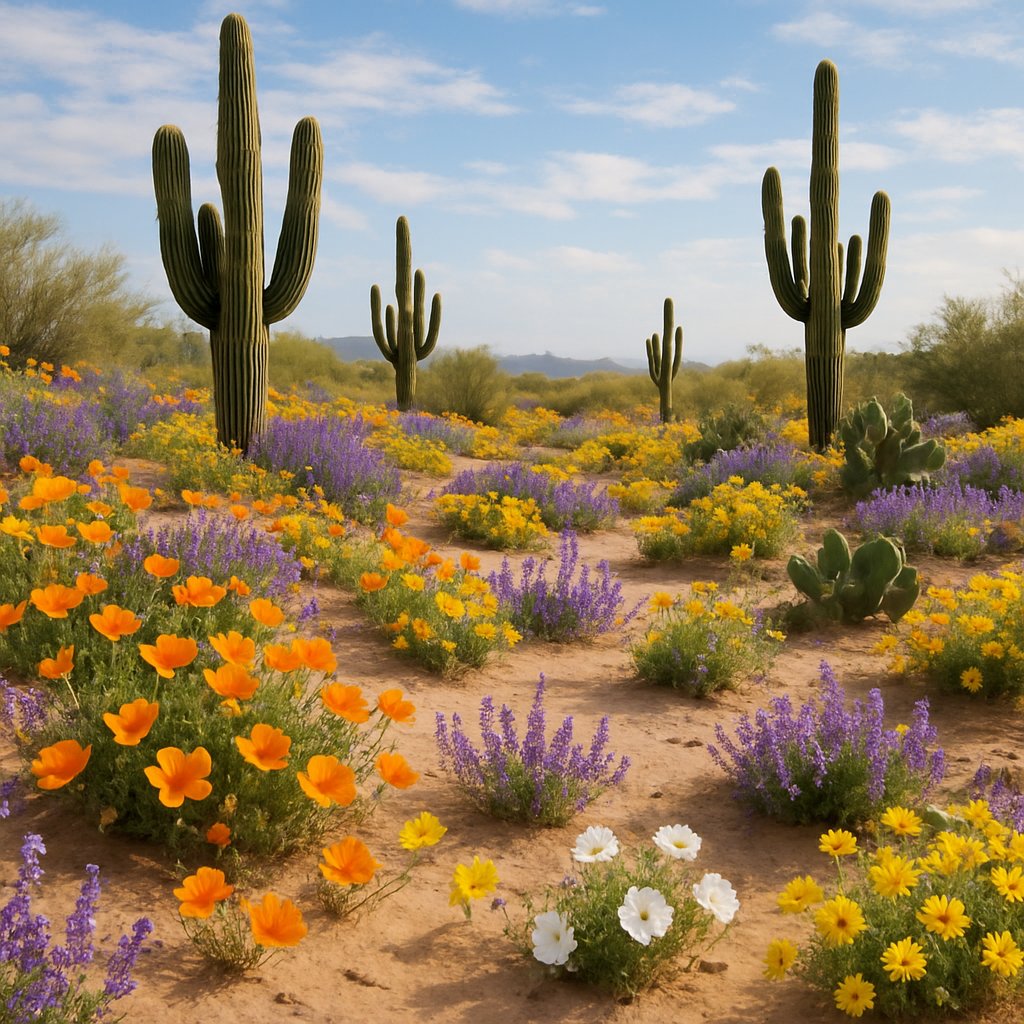
    This is where desert annuals get clever. Plants like the desert marigold (Baileya multiradiata) and California poppy (Eschscholzia californica) don’t try to survive extreme heat at all – they simply avoid it. Their seeds can lie dormant in bone-dry soil for years, sometimes over a decade, waiting for the specific combination of rainfall and temperature that signals it’s safe to germinate. Once triggered, they race through their entire life cycle – germination, growth, flowering, seed production – in a matter of weeks, before the heat returns.

    I find this strategy oddly comforting, honestly. It’s not about toughing it out; it’s about timing. The desert marigold doesn’t fight the environment, it reads it.

    desert wildflowers blooming across sandy terrain with cactus

    Strategy three: engineer the leaves and roots

    Many perennial desert flowers reduce water loss through structural tricks:

    • Small or absent leaves. Ocotillo, for instance, drops its leaves during dry spells and only grows them back within days of rainfall, reducing the surface area available for evaporation.
    • Fuzzy or waxy coatings. Brittlebush (Encelia farinosa) has silvery, hairy leaves that reflect sunlight and trap a thin layer of humid air close to the leaf surface.
    • Deep or wide-spreading root systems. Some desert perennials send roots 20 feet or more into the soil to tap underground moisture, while others spread roots horizontally just under the surface to capture every drop of a brief rain.
    • CAM photosynthesis. A number of succulent-flowering species open their stomata (the pores that exchange gases) only at night, when it’s cooler and humidity is higher, drastically cutting water loss compared to plants that photosynthesize during the day.

    A quick comparison of desert survival tactics

    Flower Primary survival strategy Typical bloom window
    Saguaro cactus Water storage in stem tissue May – June
    Desert marigold Seed dormancy, rapid life cycle March – May (after rain)
    Ocotillo Leaf drop, opportunistic regrowth Spring and after monsoon rains
    Ice plant Succulent leaves, sun-triggered blooming Late spring through summer
    Brittlebush Reflective leaf coating February – April

    What this means if you’re gardening in a hot, dry climate

    If you live somewhere like Tucson, Las Vegas, or inland Southern California, these desert-adapted flowers aren’t just a curiosity – they’re a practical answer to water restrictions and rising utility costs. Xeriscaping, the practice of designing landscapes that need minimal irrigation, leans heavily on the same species that evolved to survive without human help.

    A few practical notes I’ve picked up from talking with desert gardeners over the years:

    • Plant in fall or early spring, not midsummer – even drought-tolerant species need a mild establishment period before facing peak heat.
    • Rocky or sandy, fast-draining soil often works better than rich garden loam, since many desert flowers are prone to root rot in soil that holds too much moisture.
    • Resist the urge to overwater. Ironically, the most common way people kill desert plants is by loving them too much with the hose.

    The bigger picture worth carrying with you

    What strikes me most about desert flowers isn’t just that they survive – it’s how many different solutions evolution has arrived at for the same problem. Some plants hoard, some plants sprint, some plants simply reshape themselves season by season. There’s no single “best” strategy, just different bets on how to handle scarcity.

    Next time you’re driving through an arid stretch of the Southwest and spot a flash of orange or violet against the gravel, it’s worth pulling over for a closer look. That flower has likely survived conditions that would kill most garden plants within days – not through brute toughness, but through a set of adaptations refined over an extraordinary span of time. If the topic interests you, botanical gardens in Phoenix, Tucson, and Palm Desert offer some of the best hands-on collections in the country for seeing these strategies up close.

Our partners

My Global Flowers My Global Flowers IT My Global Flowers UK My Global Flowers AE My Global Flowers ES My Global Flowers FR My Global Flowers DE My Global Flowers AT My Global Flowers CH