Every morning, a lotus bud rises from muddy water, opens its petals to the sun, and by evening closes again. Now imagine watching this ritual 4,000 years ago on the banks of the Nile, in a pond in the Ganges plain, or in a Chinese monastery garden. You would likely draw the same conclusion in each place: something pure is emerging from darkness. Yet the three cultures read that image in surprisingly different ways. Here is how the lotus came to mean so much in Egypt, India and China, and why those meanings still turn up in tattoos, yoga studios and museum galleries across the United States.
Why the lotus caught the human imagination
The plant’s biology does most of the storytelling. Its roots sit in silt, its leaves repel water (a property scientists now call the “lotus effect,” which inspired self-cleaning coatings), and its flower opens and closes in a daily rhythm. Some species also produce seeds that stay viable for centuries. Researchers have germinated lotus seeds recovered from a dry lake bed in China that were roughly 1,300 years old.
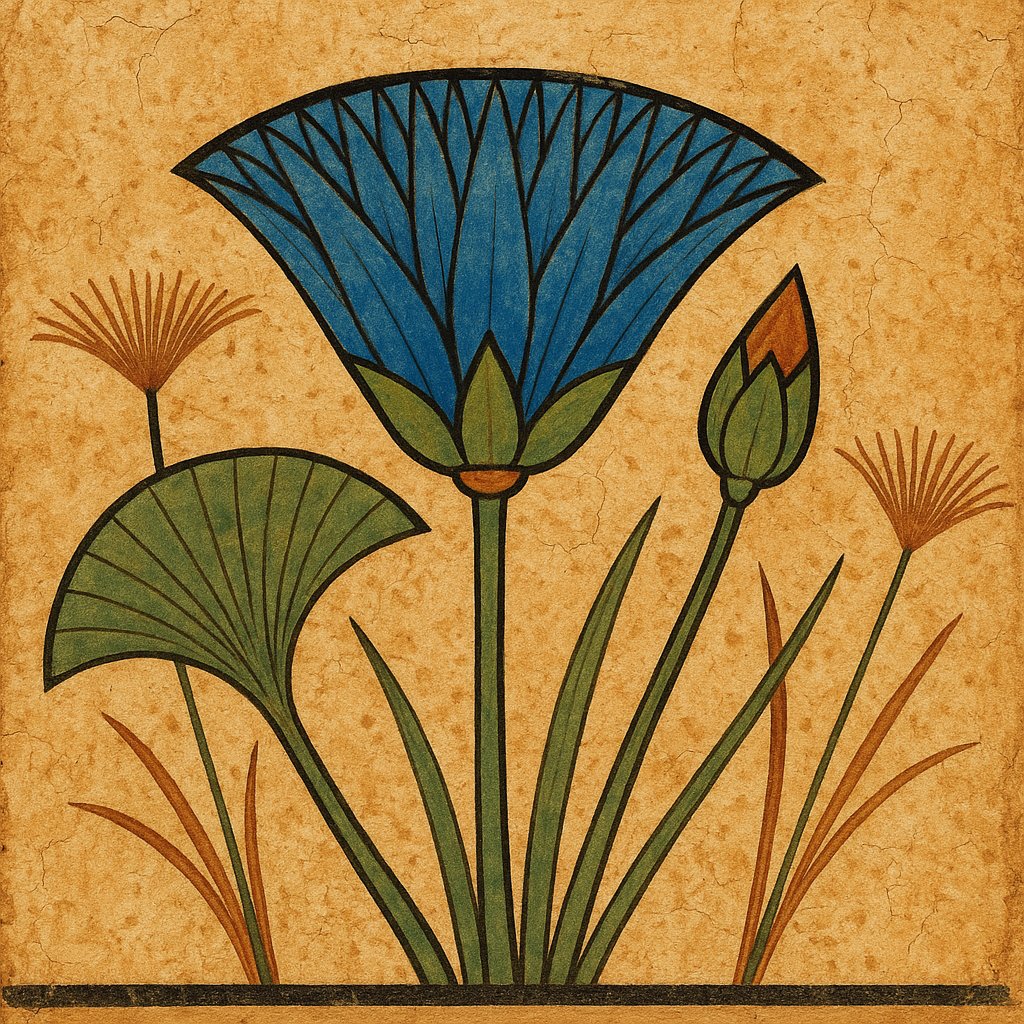
A quick note on terminology: the flower in Egypt was usually the blue water lily (Nymphaea caerulea) and the white Nymphaea lotus, which are technically water lilies. The sacred lotus of India and China is Nelumbo nucifera. Ancient artists and later writers blended the two, and the symbolism overlaps for good reason.
Egypt: the flower that opened the world
Creation and the sun
In Egyptian cosmology, the world began as dark, watery chaos called Nun. According to the Hermopolitan and Heliopolitan traditions, a lotus rose from those waters and opened to reveal the young sun god, whose light began creation. It is easy to see the logic: every dawn on the Nile, blue lilies unfurled at sunrise and sank slightly at dusk.
Rebirth after death
This is why the lotus appears so often in funerary art. Chapter 81 of the Book of the Dead contains spells allowing the deceased to transform into a lotus and be reborn. Tutankhamun’s treasures include a famous painted wooden head of the boy king emerging from a blue lotus. Mourners and banquet guests in tomb paintings hold the flower to their noses, perhaps for its mild sedative scent, perhaps for its symbolic promise of renewal.
Upper Egypt’s emblem
The lotus also had a political life. It stood for Upper Egypt, paired with papyrus for Lower Egypt, and columns carved as lotus and papyrus bundles still hold up temple halls at Luxor and Karnak. Together they expressed a unified kingdom.
India: purity that does not cling
In India the lotus (padma or kamala) is less about the sun’s first dawn and more about the spiritual life. The central image is a flower that grows in mud yet stays unstained. The Bhagavad Gita (5.10) says that a person who acts without attachment is untouched by sin, “as a lotus leaf is untouched by water.” I find that line one of the most practical readings of the symbol: engage with the world, but do not be coated by it.
- Hinduism: Vishnu is born with a lotus growing from his navel, from which Brahma emerges to create the universe. Lakshmi, goddess of prosperity, sits or stands on a lotus. Saraswati is often shown with one too.
- Buddhism: Legend says the infant Buddha took seven steps and lotuses bloomed beneath each foot. Buddhas and bodhisattvas are commonly seated on lotus thrones. A closed bud, a half-open flower and a full bloom can represent stages on the path to awakening.
- Yoga and the body: The “thousand-petaled lotus” at the crown of the head represents the highest state of consciousness in tantric traditions, and the seated pose padmasana takes its name from the flower.
- National identity: The lotus has been India’s national flower since independence.
Color matters here. Pink usually points to the Buddha himself, white to purity of mind, red to compassion and love, and blue to wisdom and the victory of spirit over senses.
China: integrity, harmony and a scholar’s favorite
Buddhism carried Indian lotus imagery into China, but the flower already had a Chinese life of its own. The best-known statement comes from the Song dynasty scholar Zhou Dunyi, whose essay “On the Love of the Lotus” (11th century) describes it as the gentleman among flowers: “rising from the mud yet unstained, washed by clear ripples yet not seductive.” For centuries Confucian scholars cited it as a model of moral integrity, especially for officials who were tempted by corruption.
Chinese culture also loves a good pun. The word for lotus, lian (莲), sounds like words meaning “connected” and “continuous,” while he (荷) sounds like “harmony.” A lotus paired with a fish suggests surplus year after year, and lotus seeds, with their many pods, are linked to fertility and wishes for many children, which is why they feature in wedding sweets. In Chinese Buddhism, the Pure Land tradition imagines believers being reborn inside lotus blossoms in Amitabha’s paradise.
Three cultures, one flower: what differs
| Culture | Core idea | Typical setting |
|---|---|---|
| Egypt | Creation, sun, rebirth after death | Tombs, temple columns, funerary art |
| India | Spiritual purity, detachment, awakening | Temples, deity iconography, meditation |
| China | Moral integrity, harmony, abundance | Scholar paintings, festivals, folk art |
Put simply, Egypt looks at the lotus as a cosmic event, India as an inner path, and China as a code of conduct. The shared thread is emergence: something clean and luminous rising out of murk.
Reading lotus imagery with a sharper eye
The next time you see a lotus in a museum, a textile or a piece of jewelry, a few questions help. Is it blue and sharply pointed, like a water lily from the Nile? Is it a broad pink bloom with a seed pod, typical of Nelumbo? Is a deity seated on it? Is it paired with a fish or a bird? Those details usually reveal which tradition is speaking, and one carelessly chosen design can carry a very different message than the person wearing it intended.
If this overview sparked your curiosity, a good next step is to look at primary sources: a translation of the Egyptian Book of the Dead, the Bhagavad Gita, or Zhou Dunyi’s short essay, which takes about two minutes to read. Seeing the lotus in the words of the people who revered it is a quiet, rewarding way to understand why a muddy-pond flower has held human attention for millennia.