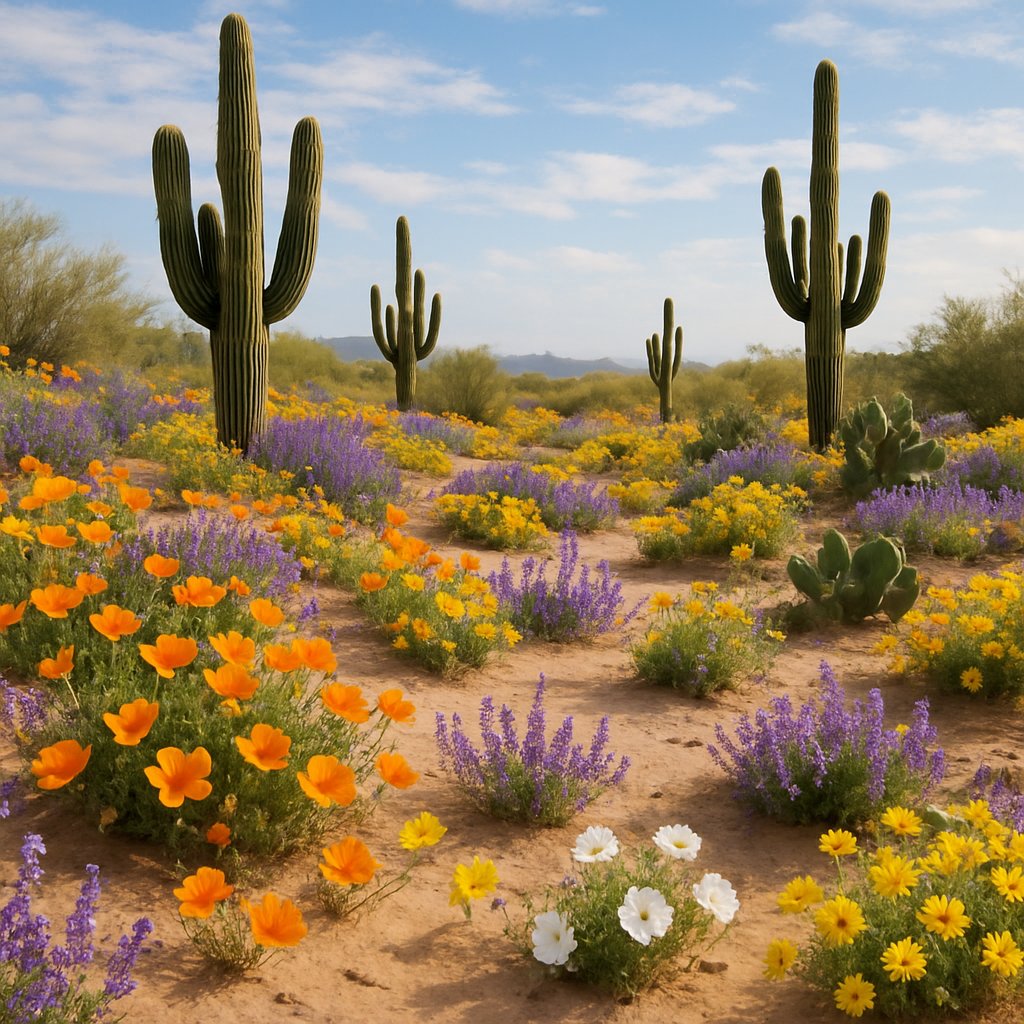
Walk through Death Valley in late March after a wet winter, and you might stumble into something that looks almost impossible: a carpet of golden and violet blooms stretching across ground that, for eleven months of the year, looks like the surface of another planet. I remember reading a ranger’s account of the 2005 “superbloom” and thinking – how does anything with petals that delicate survive a place that regularly hits 120°F? The answer turns out to be a masterclass in botanical problem-solving, and it’s worth understanding, whether you’re a gardener in Phoenix or just someone fascinated by how life refuses to quit.
Why deserts aren’t actually empty of flowers
Deserts are defined by scarcity of water, not scarcity of life. In fact, some of the most floristically diverse regions on Earth – the Sonoran Desert, the Chihuahuan Desert, parts of the Mojave – host hundreds of flowering species. What separates a desert flower from a garden-variety annual isn’t luck. It’s a set of physiological and behavioral adaptations refined over millions of years.
Three pressures shape everything: extreme heat, minimal and unpredictable rainfall, and intense sunlight that can scorch unprotected tissue. Desert flowers have evolved roughly three strategies to cope, and most species combine more than one.
Strategy one: store water like a bank account
Succulent flowering plants – cacti being the obvious example – hold water in thickened stems, leaves, or roots. The saguaro cactus, which produces waxy white blooms every May and June, can hold up to 200 gallons of water in its trunk after a good rain, expanding like an accordion to accommodate it. The desert rose (Adenium obesum), despite its name suggesting fragility, stores water in a bulbous stem base called a caudex and can go months without irrigation while still pushing out clusters of pink, trumpet-shaped flowers.
Ice plants (Delosperma) take a similar approach on a smaller scale. Their fleshy leaves are packed with water-storing cells, and their daisy-like flowers – often in shocking magenta or orange – open only when the sun is strong enough to justify the metabolic cost of blooming.
Strategy two: skip the hard part entirely
This is where desert annuals get clever. Plants like the desert marigold (Baileya multiradiata) and California poppy (Eschscholzia californica) don’t try to survive extreme heat at all – they simply avoid it. Their seeds can lie dormant in bone-dry soil for years, sometimes over a decade, waiting for the specific combination of rainfall and temperature that signals it’s safe to germinate. Once triggered, they race through their entire life cycle – germination, growth, flowering, seed production – in a matter of weeks, before the heat returns.
I find this strategy oddly comforting, honestly. It’s not about toughing it out; it’s about timing. The desert marigold doesn’t fight the environment, it reads it.
Strategy three: engineer the leaves and roots
Many perennial desert flowers reduce water loss through structural tricks:
- Small or absent leaves. Ocotillo, for instance, drops its leaves during dry spells and only grows them back within days of rainfall, reducing the surface area available for evaporation.
- Fuzzy or waxy coatings. Brittlebush (Encelia farinosa) has silvery, hairy leaves that reflect sunlight and trap a thin layer of humid air close to the leaf surface.
- Deep or wide-spreading root systems. Some desert perennials send roots 20 feet or more into the soil to tap underground moisture, while others spread roots horizontally just under the surface to capture every drop of a brief rain.
- CAM photosynthesis. A number of succulent-flowering species open their stomata (the pores that exchange gases) only at night, when it’s cooler and humidity is higher, drastically cutting water loss compared to plants that photosynthesize during the day.
A quick comparison of desert survival tactics
| Flower | Primary survival strategy | Typical bloom window |
|---|---|---|
| Saguaro cactus | Water storage in stem tissue | May – June |
| Desert marigold | Seed dormancy, rapid life cycle | March – May (after rain) |
| Ocotillo | Leaf drop, opportunistic regrowth | Spring and after monsoon rains |
| Ice plant | Succulent leaves, sun-triggered blooming | Late spring through summer |
| Brittlebush | Reflective leaf coating | February – April |
What this means if you’re gardening in a hot, dry climate
If you live somewhere like Tucson, Las Vegas, or inland Southern California, these desert-adapted flowers aren’t just a curiosity – they’re a practical answer to water restrictions and rising utility costs. Xeriscaping, the practice of designing landscapes that need minimal irrigation, leans heavily on the same species that evolved to survive without human help.
A few practical notes I’ve picked up from talking with desert gardeners over the years:
- Plant in fall or early spring, not midsummer – even drought-tolerant species need a mild establishment period before facing peak heat.
- Rocky or sandy, fast-draining soil often works better than rich garden loam, since many desert flowers are prone to root rot in soil that holds too much moisture.
- Resist the urge to overwater. Ironically, the most common way people kill desert plants is by loving them too much with the hose.
The bigger picture worth carrying with you
What strikes me most about desert flowers isn’t just that they survive – it’s how many different solutions evolution has arrived at for the same problem. Some plants hoard, some plants sprint, some plants simply reshape themselves season by season. There’s no single “best” strategy, just different bets on how to handle scarcity.
Next time you’re driving through an arid stretch of the Southwest and spot a flash of orange or violet against the gravel, it’s worth pulling over for a closer look. That flower has likely survived conditions that would kill most garden plants within days – not through brute toughness, but through a set of adaptations refined over an extraordinary span of time. If the topic interests you, botanical gardens in Phoenix, Tucson, and Palm Desert offer some of the best hands-on collections in the country for seeing these strategies up close.








